THE framework
The Operating Clarity Framework
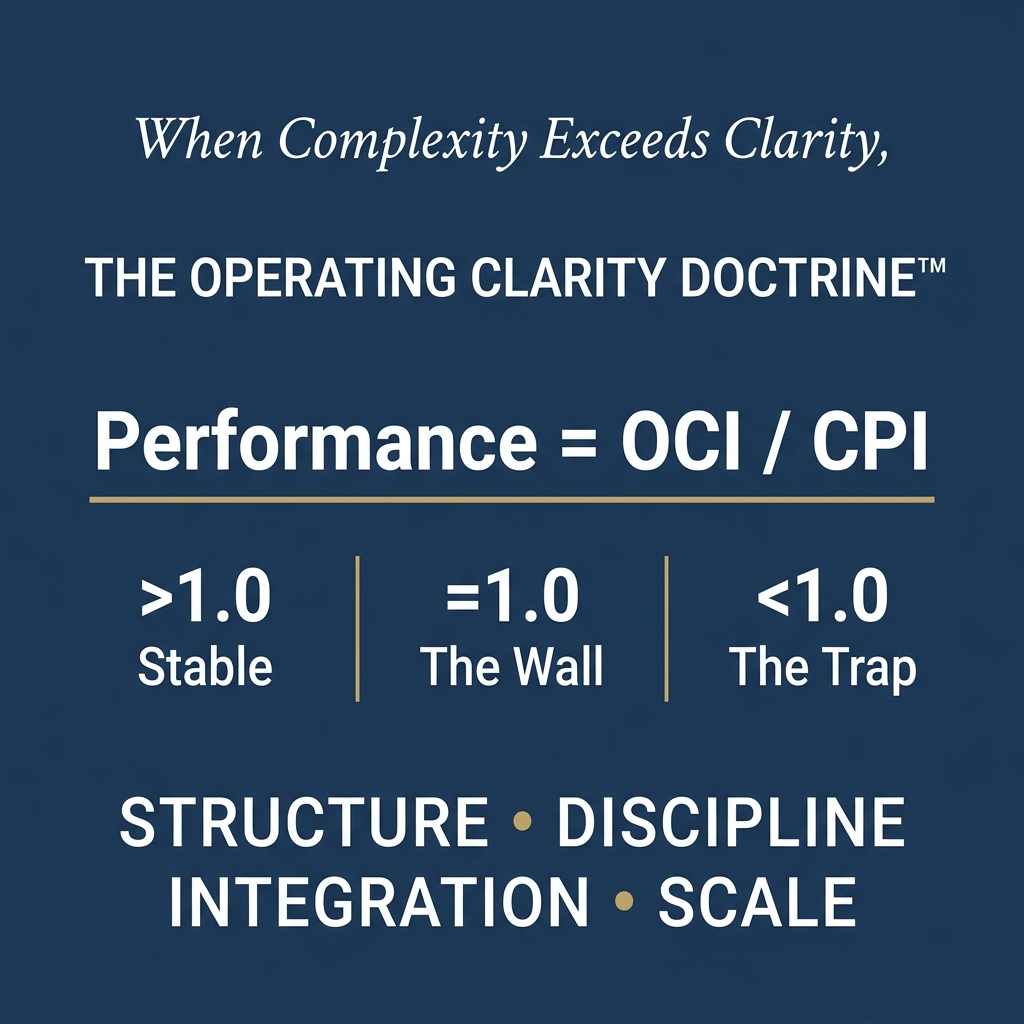
The doctrine can be understood through a simple operating model:
The Law of Operating Clarity™
↓
$300M Complexity Wall™
↓
Supply Chain Trap™
↓
SDIS™
Each layer represents a stage of the scaling constraint companies encounter as they grow.
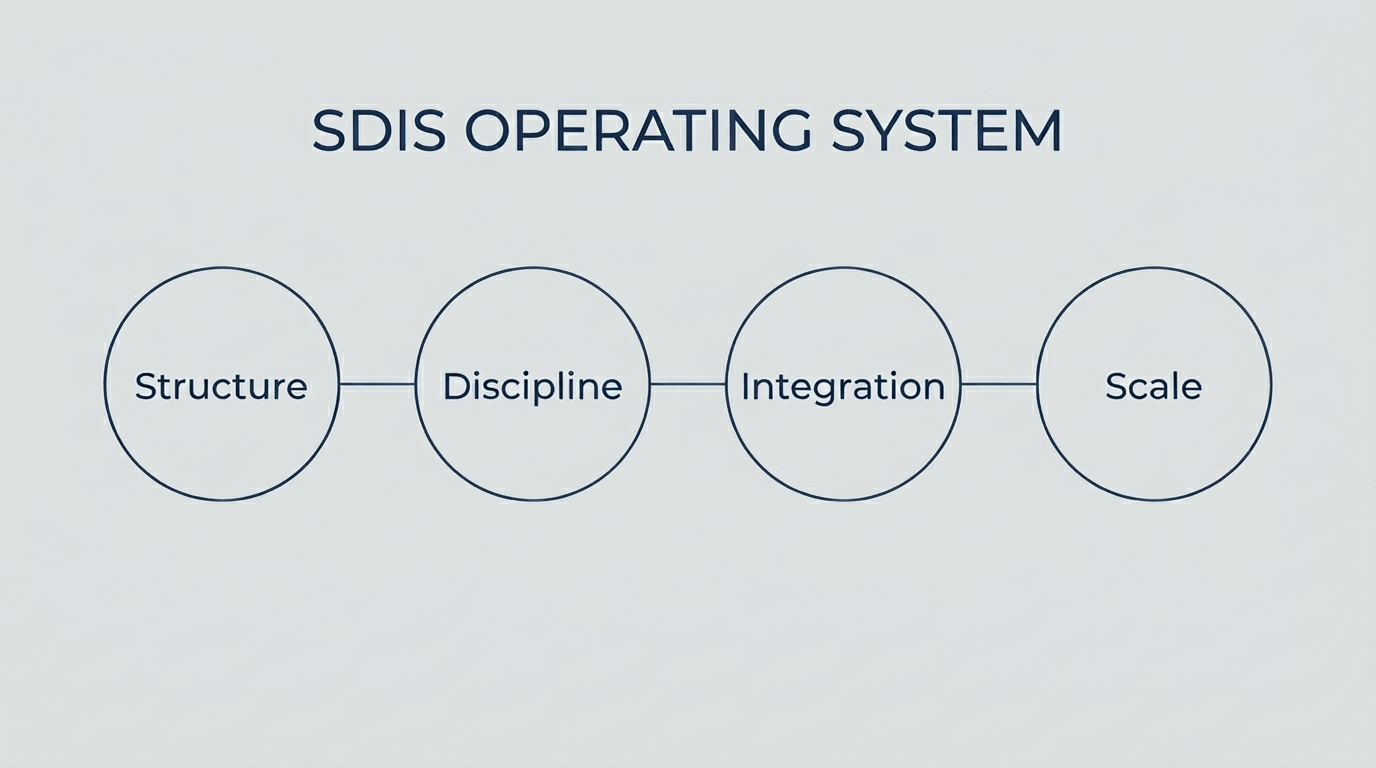
SDIS™ resolves the Complexity Wall through four operating principles:
why now
Why This Matters Now
- Supply chains are more complex.
- Product portfolios are expanding.
- Global sourcing increases coordination costs.
Yet most organizations still operate with management systems designed for companies half their size.
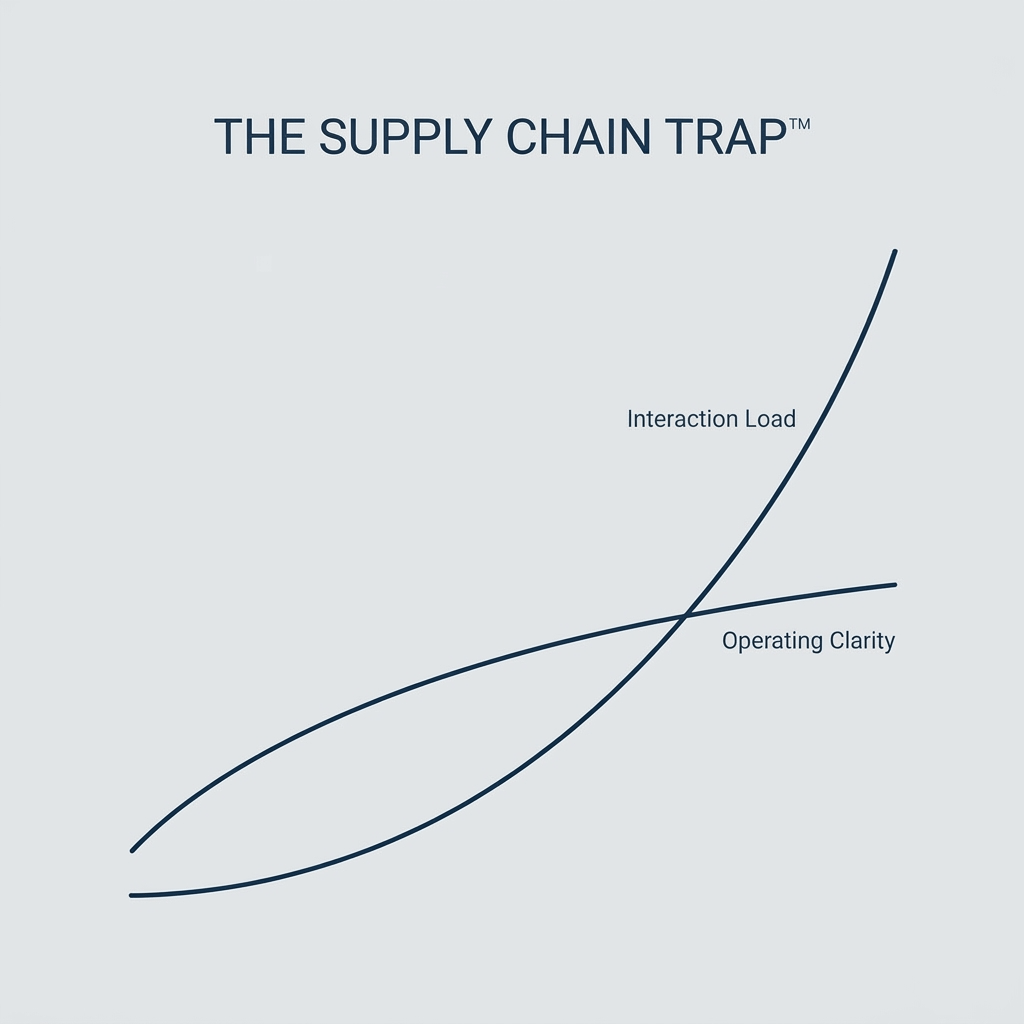
Eventually complexity begins growing faster than clarity.
the law
The Law of Operating Clarity™
When enterprise complexity grows faster than operating clarity, performance stalls.

the wall
The $300M Complexity Wall
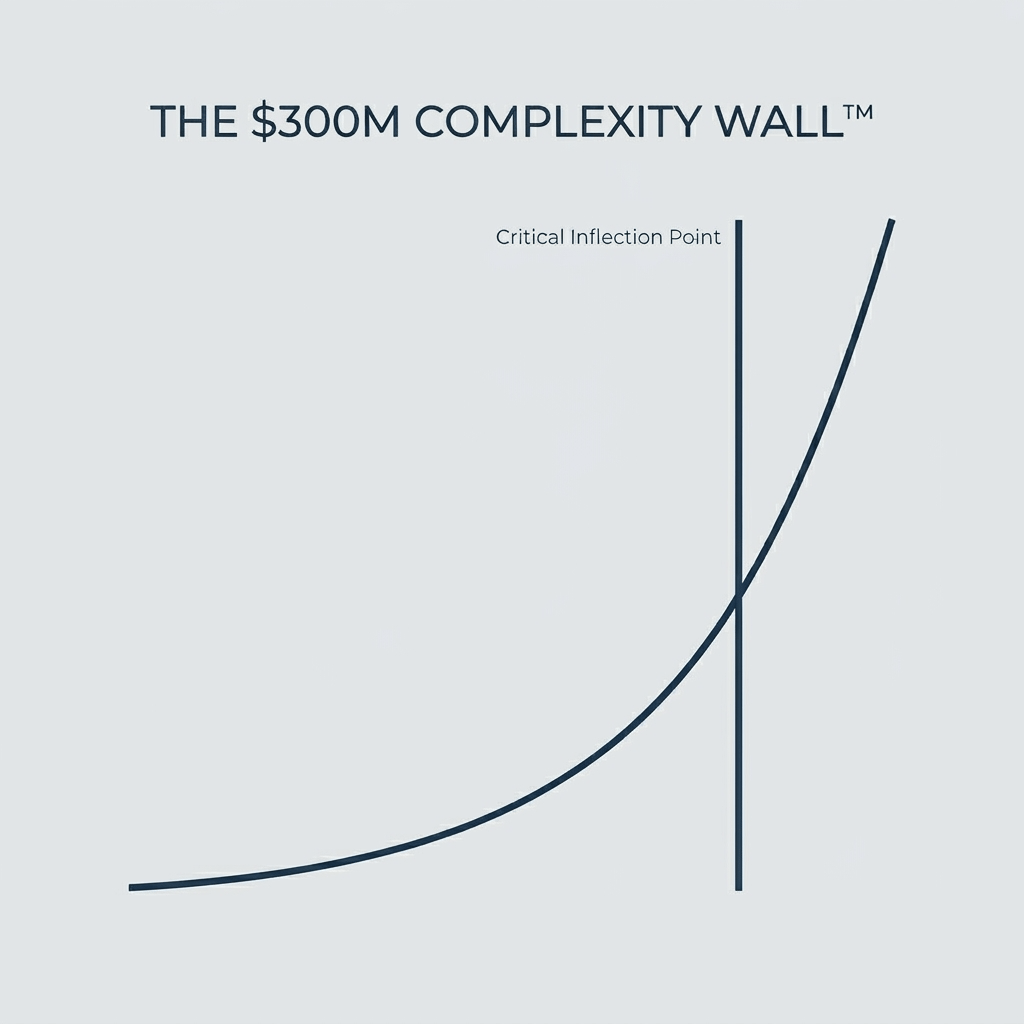
As companies scale from roughly $100M to $350M in revenue, enterprise complexity begins to grow faster than organizational capability.
Revenue grows exponentially.
Operating clarity typically grows linearly.
When complexity overtakes clarity, organizations hit the Wall.
Every scaling company eventually encounters the same structural constraint: the Complexity Wall.

Continue to the SDIS Systemthe trap
The Supply Chain Trap™
What happens when companies hit the Complexity Wall™:
Inventory rises
Service levels fall
Expedite culture becomes normal
Planning teams drown in spreadsheets
Meetings multiply
Accountability disappears
Leaders hire more people
Nothing stabilizes
These are not execution failures.
They are the symptoms of a system that has outgrown its design.

SDIS™ is the operating system designed to restore clarity as complexity scales.
sdis
SDIS™
SDIS resolves the Complexity Wall through four operating principles:
STRUCTURE
Decision rights before process
Clear ownership of planning, procurement, and execution removes organizational friction and establishes operating clarity.
DISCIPLINE
Repeatable execution systems
Standard operating rhythms, governance structures, and metrics ensure the organization performs consistently.
INTEGRATION
Functions operating as one system
Procurement, planning, operations, and finance operate through shared data and aligned decision frameworks.
SCALE
Processes designed for growth.
Systems evolve with complexity so the organization can expand revenue without expanding chaos.
SSDIS converts operating clarity into a compounding operating advantage.
Start the Conversationimpact
What Operating Clarity Delivers
When companies escape the Supply Chain Trap™,
operational clarity begins compounding into EBITDA expansion and cash generation.
Operational Stability
Leadership Alignment
Scalable Growth
Execution becomes predictable.
Decisions move faster because ownership becomes clear.
The operating system evolves as complexity increases.
Planning, procurement, and operations operate through shared rhythms and decision structures.
Leadership teams operate from shared metrics and governance rather than functional silos.
Companies expand revenue without expanding chaos.
- Service levels stabilize
- Expedite culture disappears
- Inventory begins declining while service improves
- Clear decision rights
- Reduced organizational friction
- Faster cross-functional execution
- Multi-site growth becomes manageable
- Systems integrate rather than fragment
- Scale becomes intentional rather than reactive
Operating clarity converts complexity from a liability into a competitive advantage.

application
Who is This For?
Emerging Complexity
At the Complexity Wall
Scaling Beyond the Wall
(Small to mid companies approaching the wall)
(The most common market)
(Mature operators)
Companies growing quickly where operational complexity is beginning to exceed informal processes.
Organizations where growth has outpaced the operating system.
Companies intentionally designing operating systems to scale with complexity.
- Revenue approaching ~$100M
- Functional silos beginning to form
- Increasing coordination friction across planning, procurement, and operations
- Inventory rising while service levels fall
- Planning teams drowning in spreadsheets
- Premium freight becoming routine
- Multi-site or global operations
- Private equity portfolio companies preparing for integration or growth
- Leadership teams aligning governance, planning, and procurement systems
the pattern
The Pattern Behind the $300M Complexity Wall
Across industries, companies follow a predictable evolution as they scale.
Early growth is driven by entrepreneurial speed and revenue expansion.
But as organizations approach the $100M–$350M range, operational complexity begins to accelerate faster than the systems designed to manage it.
━━━━━━━━━━━━━━━━━━━━━━━━
Companies do not fail because they grow too slowly.
They fail because complexity grows faster than their operating system evolves.
— The Operating Clarity Doctrine™
━━━━━━━━━━━━━━━━━━━━━━━━
The Pattern Repeats Across Industries
Industrial Manufacturing
Distribution & Logistics
Private Equity Portfolio Companies
Multi-site plants operating with disconnected planning systems
Expanding product portfolios increase planning volatility
Rapid integration of acquisitions introduces structural complexity
Procurement, planning, and operations working from different data
Forecasting and replenishment systems fall out of sync
Leadership teams inherit fragmented operating models
Inventory increases while service reliability declines
Expedite culture becomes normalized
Execution friction compounds as growth accelerates

Heading
foundation
Developed From Real Operating Experience
- The Operating Clarity Doctrine was developed from more than two decades of experience designing operating systems for complex manufacturing and supply chain environments.
- Across modular manufacturing platforms, global sourcing networks, and rapidly scaling industrial organizations, the same pattern appears repeatedly: complexity expands faster than the systems designed to manage it.
- The SDIS™ operating system is the structured response to that constraint.
founder
About the Founder
Chuck Entinger
Founder — Operating Clarity Group
20+ years building and transforming global supply chain operating systems for complex manufacturing organizations.
Chuck helps companies restore operating clarity as complexity scales.
Areas of focus:
- Procurement transformation
- Planning and supply chain governance
- Operating model design
decision
When companies hit the Complexity Wall, leadership has three choices.
STATUS QUO
INCREMENTAL FIX
SYSTEM REDESIGN
Continue operating with the existing system
Attempt incremental improvements
Redesign the operating system
Complexity continues to outpace clarity.
New tools are introduced.
Clarity is restored through structure, discipline, integration, and scale.
Execution becomes increasingly unstable.
Teams work harder.
Execution becomes predictable again.
Operational friction compounds across the organization.
But the underlying operating system remains unchanged. The complexity problem persists.
Complexity becomes manageable as the organization scales.
SDIS™ is designed for leadership teams ready to move beyond the Complexity Wall.
Operating Clarity Group
A management doctrine explaining why companies hit the $300M Complexity Wall™ and the operating system required to scale beyond it.
© 2026 Operating Clarity Group
Operating Clarity Doctrine™, $300M Complexity Wall™, and SDIS™ are intellectual property of Operating Clarity Group.